
Resend passed 1M developers: 6 startups to build on it
The email API developers love just added inbound. Six things to build on it, starting with three newsletter platforms.

Six startups to build on top of Resend
The email API developers actually enjoy just added inbound.
That turns it from a pipe into a foundation. Here is what to build on it. Three newsletter platforms, then three more.
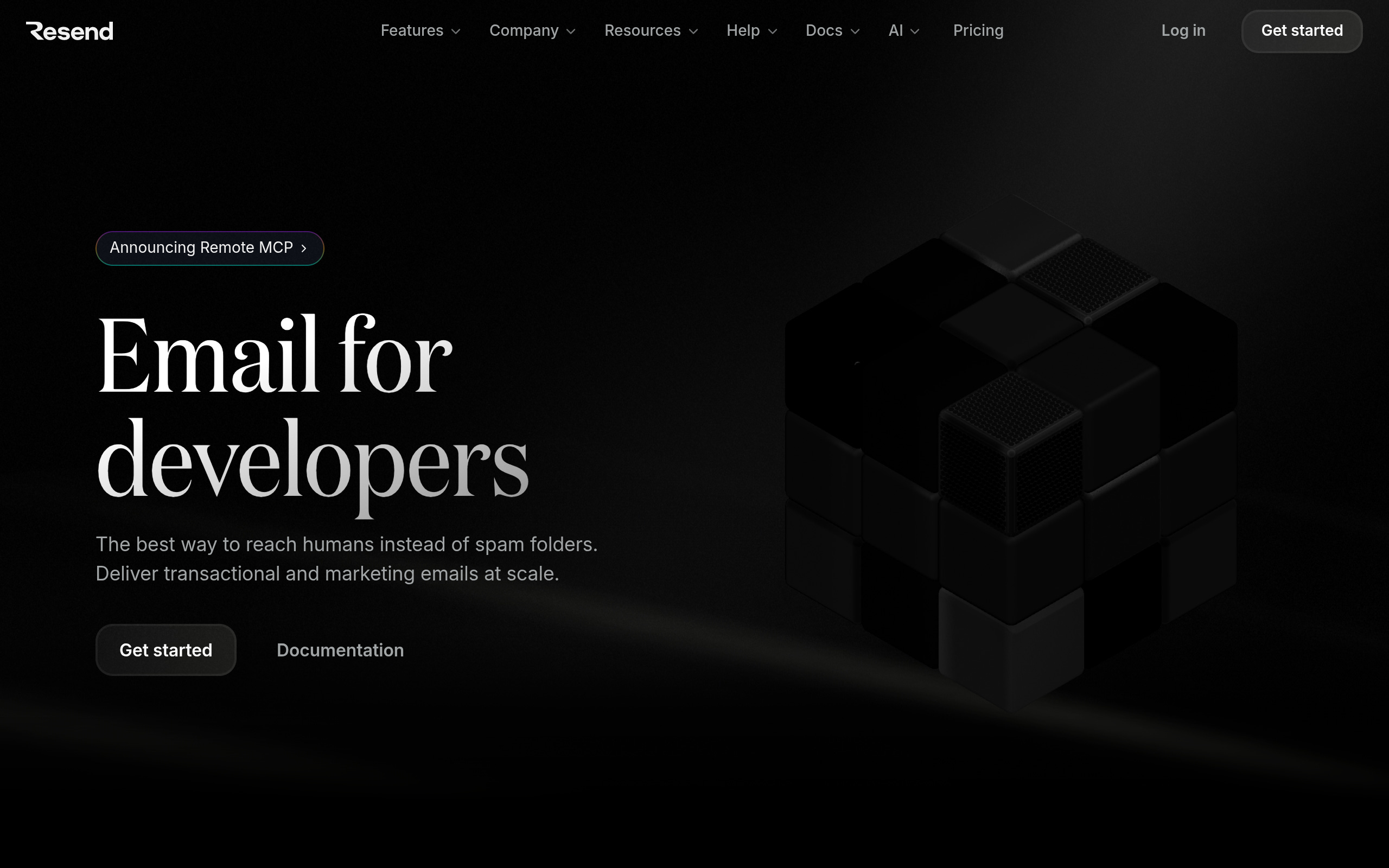
[resend.com](https://resend.com) - "Email for developers," now sending and receiving
THE PLATFORM · RESEND · MID 2026
1,000,000 developers
Resend · email for developers · founded 2023 · $18M Series A · outbound and inbound · React Email at ~1.4M weekly downloads
Substack is worth $1.1 billion. beehiiv is racing up behind it.
The newsletter is one of the most durable businesses on the internet. It has been for twenty years.
Here is the strange part. Every one of those platforms is a nice product wrapped around hard email infrastructure. Sending. Deliverability. Templates. Lists.
Resend just gave that away.
Transactional and marketing sending. React Email for templates a designer would sign off on. Broadcasts, contacts, and now inbound. A million developers showed up in under two years, so the DX is not a pitch. It is settled.
The hard part is built. The products on top are not.
Here are six worth building.
THREE NEWSLETTER PLATFORMS
1. The local newsletter network
Local newsletters print money. The tools under them were built for one solo writer, not a network of towns.
Who: Publishers running city and neighborhood newsletters. The Axios Local model, done independently.
Gap: Substack and beehiiv are horizontal. No ZIP-level targeting. No local ad marketplace. No way to run ten town titles from one place.
Build: Segment by ZIP. A self-serve page where a local sponsor books one neighborhood. One dashboard for the whole network. React Email templates a non-designer can edit.
Price:
$49–299/moper title. Flat. No cut of their revenue.Why now: Substack raised $100M at a $1.1B valuation in July 2025. beehiiv nearly doubled to a ~$30M run-rate. The category is proven, and publishers want to own the list.
Wedge: Built for local, not retrofitted. No 10% tax. Resend deliverability that keeps them out of the Promotions tab.
2. The company newsletter platform
Every company wants a newsletter. Most send an ugly one from a tool that fights their stack.
Who: B2B marketing and devrel teams running a company newsletter, digest, or changelog.
Gap: Substack and beehiiv are creator-first. No CRM sync. No lead attribution. No roles or approvals. Mailchimp fits the stack, but the email looks like 2012.
Build: React Email brand templates. Two-way sync with HubSpot and Salesforce. Attribution back to the CRM. Team roles and approvals. A web archive that ranks on Google.
Price:
$99–999/mo.Why now: Content-led growth is how B2B sells now. The Google and Yahoo rules (Feb 2024) and Outlook's enforcement (May 2025) push teams onto real infrastructure.
Wedge: A newsletter that plugs into revenue, not a creator toy bolted onto the marketing team.
3. The programmable newsletter platform
Substack has no open API. In 2026, "an agent can't run it" is a real gap.
Who: Developers, indie hackers, and the people wiring AI agents to write and send.
Gap: Substack has no free public API. A dead end for code and for agents. beehiiv gates its API behind its pricier plans.
Build: Everything through a clean API. Create a post, manage the audience, send it, read the replies through inbound. Webhooks for every event. A dashboard for the humans who still want one.
Price:
$0–49/moplus usage. A free tier to pull developers in.Why now: Resend shipped the open API, broadcasts, and inbound in 2025. AI agents now write content and need somewhere to publish it. Substack cannot follow without rebuilding.
Wedge: The only newsletter platform a script, or an agent, can run end to end.
THREE MORE, BEYOND THE NEWSLETTER
4. The support inbox
Resend now receives email and parses it to JSON. That is what a shared support inbox is made of.
Who: Small SaaS teams and startups running support out of a shared Gmail, priced out of Zendesk and Front.
Gap: Help Scout, Front, and Zendesk are built and priced for bigger teams. None are developer-native. Resend's inbound is the missing backend, sitting unused.
Build: Route a support@ domain in. Thread the conversations. Assign, set SLAs, save canned replies. An AI draft-reply trained on your own docs. A REST API so engineers can extend it.
Price:
$15–40/agent/mo.Why now: AI support went from experiment to default. Gartner's mark of 80% of service orgs using generative AI was hit by 2026. Intercom's Fin passed 40M resolved conversations by December 2025.
Wedge: Developer-native and cheap. A support inbox a five-person team approves without a meeting.
5. The lifecycle email engine
Resend sends beautifully and stores your contacts. It stops short of triggered journeys. That gap is a product.
Who: SaaS developers who need onboarding drips and behavioral email, without Customer.io's weight and price.
Gap: Customer.io and Braze are heavy and enterprise-priced. Loops is close but young. Resend does not do event-triggered journeys with branching.
Build: Track events by SDK and webhook. A journey builder that is visual for the PM and code for the engineer. React Email templates. Built-in A/B. A starter library of welcome, trial, and win-back flows.
Price:
$50–500/moby contacts and events.Why now: The email marketing software market is ~$1.8B and growing 10 to 13% a year. The Feb 2024 and May 2025 sender rules make deliverability table stakes. Resend already gives you that.
Wedge: Developer-first lifecycle email on infrastructure that lands in the inbox, without the Customer.io learning curve.
6. The inbound parser
A lot of the world's data still arrives as an email. Turn those emails into clean webhooks.
Who: Ops, RevOps, and finance teams drowning in order, lead, shipping, and invoice emails.
Gap: Mailparser and Parseur exist, but they are clunky and rule-based. None are built for a modern developer or an AI agent.
Build: Point an address at Resend inbound. Let an LLM pull out the fields. Send a clean, structured webhook to any system, or straight to a database. Templates for the common email types.
Price:
$29–299/moby volume.Why now: Resend shipped inbound parsing, with JSON, attachments, and webhooks, in 2025. LLMs made field extraction reliable this year, so the rule-builder era is ending.
Wedge: LLM extraction instead of brittle rules, on infrastructure a developer wires up in an afternoon.
WHERE TO START
Start with the programmable newsletter platform, number three.
It is the sharpest gap, and the one Substack cannot copy quickly. The build is small to begin.
Wrap Resend's API in a single "send my newsletter in one call" endpoint. Ship a demo. Post it where indie developers and AI builders hang out.
Then watch who asks to pay. Those are your first ten customers.
Want the full build plan for one of these? Reply with its number, 1 through 6, and we'll send it, free.
Forward this to the developer friend who keeps saying they'll start something. Tomorrow: another platform, more ideas.